I was born in the mid-1960s and remember the birth of cable television. Home Box Office (HBO) premiered in 1972 and soon after my family had a cable subscription.
By the early 70s I was already a huge Universal classic horror fan. Even before cable, I had seen the 1931 Karloff Frankenstein, the 1931 Lugosi Dracula, and a few of the others on the “Friday Fright Night” late show that ran after the 11:00 news on the local ABC affiliate. But cable television opened up the entire catalog to me.
In those days, cable scheduling was fast and loose. What used to be an empty spot on the dial pre-cable now might host one cable channel for part of the day and another for the rest. Most of the cable stations went off air at midnight, just like the local network affiliates, with a rendition of the national anthem.
One such channel in the Buffalo, N.Y. market (I don’t remember the dial number) carried WPIX Channel 11 from New York City (NYC) on Saturday mornings until 10 AM. There was a god-awful children’s show about a leprechaun named “Harrigan” until 9:30, at which time an episode of the 1960s Spiderman cartoon series would come on. I timed breakfast so that I was finished just in time to hear as little of the Harrigan outro theme song as possible without missing the teaser for Spiderman.
But that was just the warmup act for what followed. At 10 AM, the station would switch from WPIX Channel 11 NYC to WOR TV Channel 9 NYC. And every Saturday morning at that time, a 1930s or 1940s film would be shown. These included the Universal classic horror films – usually the B movie sequels, not the originals. However, they tended to run them in multi-week series. So, if The Mummy’s Hand (1940) were shown one Saturday, then the Mummy’s Tomb (1942) would show the next, The Mummy’s Ghost (1944) the week after, and The Mummy’s Curse (1944) the week after that.
Ditto with the Frankenstein films. If Son of Frankenstein (1939) played the first week, it likely would be followed in successive weeks by Ghost of Frankenstein (1942), Frankenstein Meets the Wolfman (1943), House of Frankenstein (1944), and House of Dracula (1945).
I was like a prospector who had hit the mother lode.
Of course, it wasn’t just the Universal classic horror films that played in the 10 AM slot. When they weren’t running those, they would run other films from the same period, which I came to enjoy almost as much. It was on WOR Channel 9 that I first encountered The Saint.
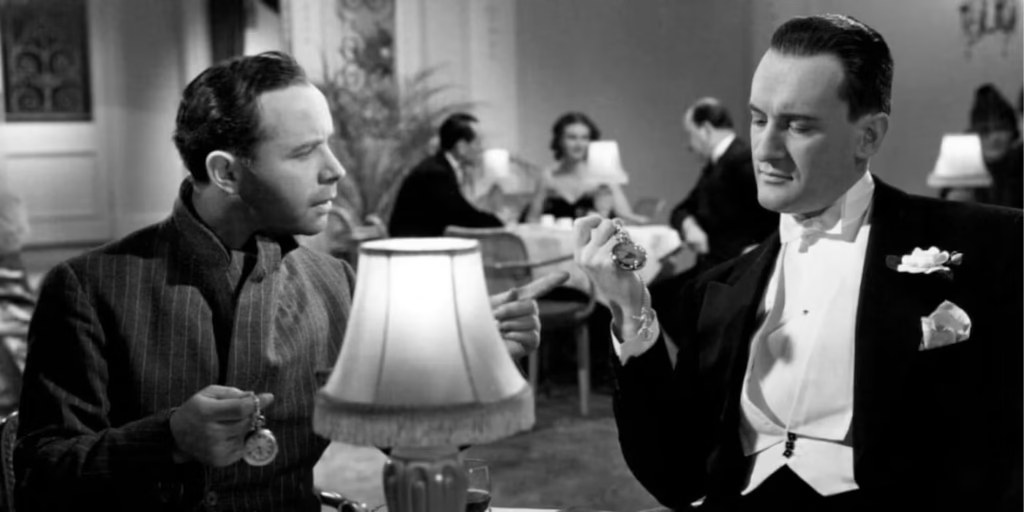
In keeping with the pattern, I don’t believe I saw the first of the RKO Saint series starring Louis Hayward in the title role. My entire exposure to the Saint was the following five films starring George Sanders. As far as I was concerned, George Sanders was The Saint. I had no knowledge of the Leslie Charteris novels and short stories wherein the character had been created. Neither did The Saint’s ideological significance occur to me at that age.
After finally reading several of the Charteris novels (Meet the Tiger, Enter the Saint, The Last Hero aka The Saint Closes the Case, The Avenging Saint) and rewatching the five Sanders films (conveniently sold in one DVD collection), it is obvious Simon Templar inspired Ian Fleming’s James Bond, even if Fleming never publicly acknowledged it.
Templar is essentially Bond’s prototype: a suave Englishman with expensive tastes, a predilection for fast cars, a way with beautiful women, and a habit of delivering sharp one-liners while facing deadly threats and taking on sophisticated criminals. But one thing makes Simon Templar far better than James Bond:
Read the rest on Tom’s Substack…
Tom Mullen is the author of Where Do Conservatives and Liberals Come From? And What Ever Happened to Life, Liberty and the Pursuit of Happiness? Part One and host of the Tom Mullen Talks Freedom podcast.